
Denver Airport Murals, Blucifer and Art: The Real Stories
Denver International Airport (DEN) is famous for more than flights. It has strange murals, a giant blue horse with glowing red eyes, gargoyles hiding in suitcases, and decades of conspiracy theories. Here are the real stories behind the Denver airport murals and art, and where to see them.
Quick facts
| Opened | Feb. 28, 1995 |
| Terminal | Jeppesen Terminal, with its famous white tent roof |
| Most famous art | Leo Tanguma’s murals, Blue Mustang (“Blucifer”), Notre Denver gargoyles |
| Funding | Denver’s 1% for Art program |
| Train to downtown | RTD A Line, about 37 minutes to Union Station |
The Leo Tanguma murals
Artist Leo Tanguma painted two huge murals for the airport. They’re the source of many conspiracy theories, but their real message is about peace and protecting nature. They follow the tradition of Mexican social-realist murals.
- In Peace and Harmony with Nature shows a sad, destroyed world, then a healing one, with children of the world gathered around a plant.
- The Children of the World Dream of Peace shows a soldier with a sword and gas mask, which shocks people, before the children turn the weapons into peace.
Where are they now? The murals were removed during the Great Hall construction. DEN said In Peace and Harmony with Nature returned to Level 5 of the Great Hall (northwest side) in August 2026. The Children of the World Dream of Peace was expected to return later, around 2028. Check DEN’s art pages for the latest.
Blue Mustang, aka “Blucifer”
As you drive in on Peña Boulevard, you’ll see a 32-foot blue horse rearing up, with glowing red eyes. It’s Blue Mustang by New Mexico artist Luis Jiménez.
- It’s made of cast fiberglass over a steel frame and weighs about 9,000 pounds.
- In 2006, while Jiménez was working on it, a section of the sculpture came loose from a hoist and killed him in his studio. His team finished it, and it was unveiled in 2008.
- The red eyes honor his father, who ran a neon sign shop.
- Locals call it “Blucifer,” a nickname the artist’s family doesn’t like.
The gargoyles in baggage claim
Look up above baggage claim. Two bronze gargoyles are sitting inside suitcases. The work is called Notre Denver, by artist Terry Allen (1994), and it’s a joke about the airport’s famous lost luggage in its early days. In 2019, DEN even added a talking animatronic gargoyle.
The tent roof
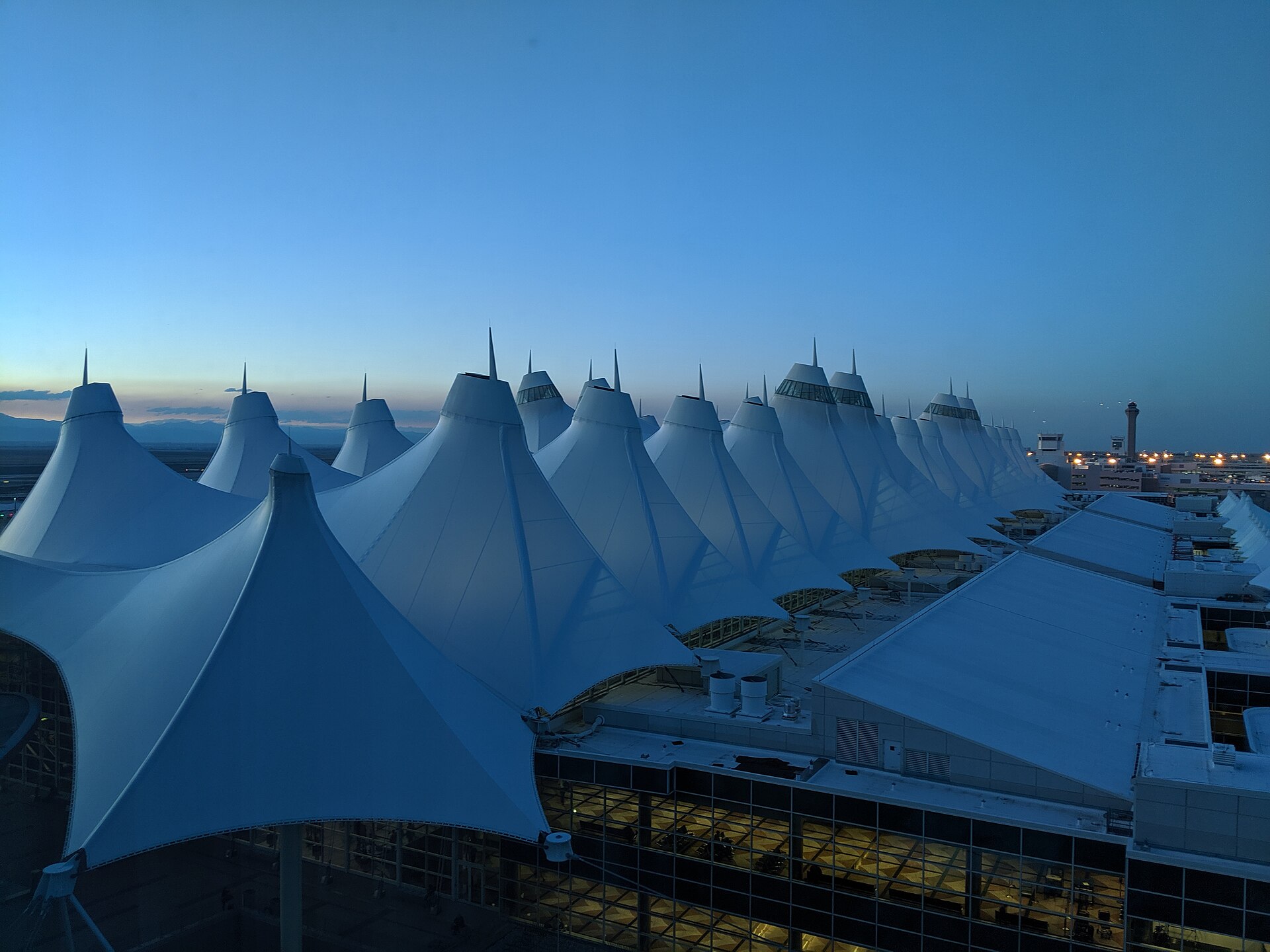
The Jeppesen Terminal’s white roof is made of Teflon-coated fiberglass fabric held up by steel cables. Its peaks are meant to look like the snow-capped Rocky Mountains, and also the tipis of the Great Plains. It’s one of the most recognizable airport roofs in the world.
The conspiracy theories (and how DEN embraced them)
Underground bunkers, secret societies, lizard people… DEN has heard them all. Instead of fighting them, the airport made them a joke:
- In 2016, it held an exhibit called “Conspiracy Theories Uncovered.”
- In 2018, it covered Great Hall construction walls with funny posters of aliens, lizards in hard hats and Illuminati jokes.
The truth is less exciting: the murals are about peace, and the “tunnels” are mostly the train and baggage systems.
Getting from the airport to Denver
- A Line train: about 37 minutes to Union Station, running about every 15 minutes at busy times. The airport fare is about $10 (an RTD airport day pass). Check RTD for current prices.
- Once downtown, see our list of free things to do in downtown Denver, and our guide to Denver walking tours.
- Heading to the mountains? See Denver to Breckenridge or Denver to Vail.
FAQ
What are the Denver airport murals about?
Leo Tanguma’s murals are about protecting nature and choosing peace over war. They show destruction first, then children of the world healing the planet.
Why is the Denver airport horse called Blucifer?
Because of its blue body and glowing red eyes, and because the sculpture killed its artist, Luis Jiménez, when a piece fell on him in 2006.
Are the Denver airport murals still there?
They were removed during Great Hall construction. DEN said In Peace and Harmony with Nature returned to Level 5 in 2026, and the second mural is expected back later.
Where are the gargoyles at Denver airport?
Above baggage claim in the Jeppesen Terminal. The piece is called Notre Denver, by Terry Allen.
How do you get from Denver airport to downtown?
Take RTD’s A Line train to Union Station. It takes about 37 minutes, and the fare is about $10.
Featured photo: Peterquinn925 / Wikimedia Commons (CC BY-SA 4.0)